终极三国
$5,000 grew into a forest: American donor returns to China to reunite with desert reclamation partner_我的网站

一 |
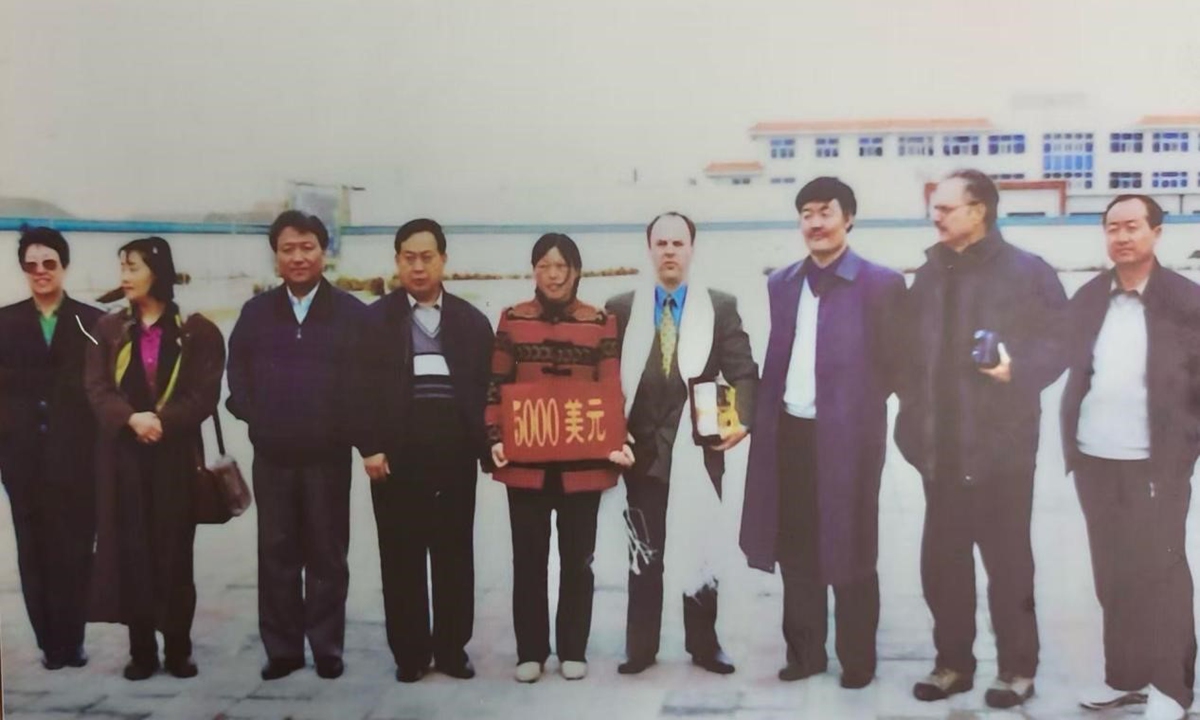
A group photo from the 1999 donation ceremony, where Ronald Sakolsky presents $5,000 for afforestation efforts. Photo: Courtesy of Luoyang No.2 Foreign Language School
At 2:48 am on early Sunday morning, after a flight of more than 10 hours, Ronald Sakolsky arrived at Beijing Capital International Airport. As he stepped into the arrivals hall, he greeted the waiting reporters with earnest Putonghua "Wo hui lai le," meaning "I'm back."
The thrill of his homecoming had washed over him most vividly during the final moments of his flight. "When I saw the lights in Beijing as we were landing is when I realized that I am back in my second home."
Sakolsky, an American retired teacher from Pennsylvania, is visiting China from Sunday to September 1 for a journey that will take him to Beijing, North China's Inner Mongolia Autonomous Region and Central China's Henan Province. It is a reunion nearly three decades in the making.
That reunion began with a single act of generosity. In 1999, when Sakolsky arrived in China as a participant in a bilateral teacher exchange program, he was moved by Yin Yuzhen and her husband's tireless efforts to curb desertification in the Mu Us Desert in Inner Mongolia. He raised $5,000 to fund their local tree-planting initiative. The young saplings bought with the donation have since matured into more than 50,000 full-grown trees, transforming the once desolate, sandy wasteland into a thriving green landscape.
After decades of lost contact, Yin, a national model worker renowned for her desert restoration achievements, launched an online search for her American benefactor in May, hoping to reconnect with the man who helped launch her lifelong desert reclamation mission.
What followed was a remarkable wave of online support: within less than 48 hours, a nationwide search had tracked Sakolsky down. That swift effort led to their long-awaited virtual reunion, a video call that brought them face to face for the first time in 27 years.
Asked what he is most looking forward to about this journey, Sakolsky told the Global Times that "I want to see Ms Yin, see the forests, see the students I have not seen for almost 30 years, my colleagues. I want to see the Chinese people."
The trip itself felt like a dream he never thought would come true, he added.
Now, the dream is about to come true. Later on Sunday, Sakolsky will fly to Ordos, Inner Mongolia, the site of the transformative environmental project that bound his fate with Yin's all those years ago.
During his China visit, Sakolsky will join Yin in a new tree-planting activity. He will also hold exchanges and discussions with teachers and students from the Luoyang No.2 Foreign Language School where he once taught, and participate in official China-US teacher exchange events, according to the Xinhua News Agency.
As he prepares to see the transformed landscape with his own eyes, Sakolsky shared with the Global Times about how much China itself has changed over the past two decades. From photographs, he said, he had already seen the barren desert he remembered turn into lush green forests; he had also heard that Luoyang has become far more vibrant and beautiful.
"Hopefully the message gets out to the world that Chinese and Americans can work together and make a peaceful world," he said.
。
DUBAI, United Arab Emirates -- While revealing new details about one of the most famed CIA operations of all times — the spiriting out of six American diplomats who escaped the 1979 U.S. Embassy seizure in Iran — the intelligence agency for the first time has acknowledged something else as well.The CIA now officially describes the 1953 coup it backed in Iran that overthrew its prime minister and cemented the rule of Shah Mohammad Reza Pahlavi as undemocratic.Other American officials have made similar remarks in the past, but the CIA's acknowledgment in a podcast about the agency's history comes as much of its official history of the coup remains classified 70 years after the putsch. That complicates the public's understanding of an event that still resonates, as tensions remain high between Tehran and Washington over the Islamic Republic's rapidly advancing nuclear program, its aiding of militia groups across the Mideast and as it cracks down on dissent. The “CIA’s leadership is committed to being as open with the public as possible," the agency said in a statement responding to questions from The Associated Press. "The agency’s podcast is part of that effort — and we knew that if we wanted to tell this incredible story, it was important to be transparent about the historical context surrounding these events, and CIA’s role in it.”In response to questions from the AP, Iran's mission to the United Nations described the 1953 coup as marking “the inception of relentless American meddling in Iran’s internal affairs” and dismissed the U.S. acknowledgments.“The U.S. admission never translated into compensatory action or a genuine commitment to refrain from future interference, nor did it change its subversive policy towards the Islamic Republic of Iran,” the mission said in a statement. The CIA's podcast, called “The Langley Files” as its headquarters is based in Langley, Virginia, focused two recent episodes on the story of the six American diplomats' escape. While hiding at the home of the Canadian ambassador to Iran, a two-man CIA team entered Tehran and helped them fly out of the country while pretending to be members of a crew scouting for a made-up science fiction film.The caper, retold in the 2012 Academy Award-winning film “Argo” directed by and starring Ben Affleck, offered a dramatized version of the operation, with Affleck playing the late CIA officer Antonio “Tony” Mendez. The podcast for the first time identified the second CIA officer who accompanied Mendez, naming him as agency linguist and exfiltration specialist Ed Johnson. He previously only had been known publicly by the pseudonym “Julio.”“Working with the six — these are rookies," Johnson recounts in an interview aired by the podcast. "They were people who were not trained to lie to authorities. They weren’t trained to be clandestine, elusive.” But in the podcast, another brief exchange focuses on the 1953 coup.In it, CIA spokesman and podcast host Walter Trosin cites the claims of agency historians that the majority of the CIA’s clandestine activities in its history “bolstered” popularly elected governments.“We should acknowledge, though, that this is, therefore, a really significant exception to that rule,” Trosin says of the 1953 coup.CIA historian Brent Geary, appearing on the podcast, agrees.“This is one of the exceptions to that," Geary says.Seven decades later, the 1953 coup remains as hotly debated as ever by Iran, its theocratic government, historians and others. Iran's hard-line state television spent hours discussing the coup that toppled Prime Minister Mohammad Mosaddegh on its anniversary in June. In their telling, a straight line leads from the coup to the 1979 Islamic Revolution that ultimately toppled the fatally ill shah. It still fuels the anti-Americanism that colors decisions made by the theocracy, whether in arming Russia in its war on Ukraine or alleging without evidence that Washington fomented the recent nationwide mass protests targeting it. From the U.S. side, the CIA's hand in the coup quickly was revealed as a success of Cold War espionage, though historians in recent years have debated just how much influence the agency's actions had. It also led the CIA into a series of further coups in other countries, including Guatemala, where American clandestine action in 1954 installed a military dictator and sparked a 40-year civil war that likely killed some 245,000 people.That's led to an American political reappraisal of the 1953 CIA action in Iran. Then-Secretary of State Madeleine Albright acknowledged the U.S.' "significant role" in the coup in 2000. President Barack Obama, speaking in Cairo in 2009, described the CIA's work as leading to the “overthrow of a democratically elected Iranian government.” But largely absent from the discussion was the CIA itself. After years of conflicting versions of the coup both in public and classified papers, a member of the CIA's own in-house team of historians wrote a reappraisal of the operation in a 1998 paper titled “Zendebad, Shah!” in Farsi — or “Long Live the Shah!”But despite a series of American historical documents being made public, including a major tranche of State Department papers in 2017, large portions of that CIA reappraisal remain heavily redacted despite attempts to legally pry them loose by the George Washington University-based National Security Archive. That's even after pledges by former agency directors Robert Gates and James Woolsey Jr. in the 1990s to release documents from that coup and others engineered by the agency. Further complicating any historical reckoning is the CIA's own admission that many files related to the 1953 coup likely had been destroyed in the 1960s.“It’s wrong to suggest that the coup operation itself has been fully declassified. Far from it," said Malcolm Byrne of the National Security Archive. "Important parts of the record are still being withheld, which only contributes to public confusion and encourages myth-making about the U.S. role long after the fact.”。
Current article:http://pspsq9.mexuanmeixuyaopinzheng.shop/news/20260826_203257.html
Published on:12:02:04